
Care isn't a loophole. Not anymore.
The Weight of an Open Door
Running a private, trauma-informed studio means building something rare: a room where people who have been hurt by the world, by other artists, by their own bodies, can actually exhale. That kind of space doesn't happen by accident. It's built session by session, out of patience, out of listening longer than is convenient, out of saying yes to accommodations most shops would never bother with.
Most of the time, that openness is met with the same good faith it's offered in. But not always. And when it isn't, the cost is real. Sometimes the trauma turns back on me and I become vulnerable and exposed. Holding space for other people's pain doesn't make an artist immune to being hurt by it. It just means the hurt has fewer places to land, because the whole job is staying open. There have been moments where genuine care and honest intention got read as something they never were, twisted into a version of me I don't recognize, with no real way to correct that once it starts. That's its own kind of grief, being fundamentally misunderstood by someone you were actually trying to protect.
The Passion That Doesn't Change
None of this makes me want to stop. I love this work. I love watching someone sit down carrying years of tension around a piece of their story, and stand up carrying it differently, because it finally lives somewhere they chose instead of somewhere it just happened to them. That's not a small thing to get to witness, over and over, for a living. It's the whole reason this studio exists in the form it does.
I hate that I have to add safeguards. I hate tightening policies, rethinking how much of myself I let show up in a session, building systems around other people's tantrums instead of just being present with them. None of that is why I got into this work, and none of it is the version of this job I'd choose if people always met the space the way it's offered.
But I have to, and I will. What I won't do is let any of that turn me into something cold. I'm going to keep doing this exactly the way I set out to do it: compassionate, healing, and real. I'm just going to do it while also protecting myself, this shop, and the artists who come up under me, because caring about people and protecting myself from the ones who take advantage of that care were never actually in conflict. They just have to happen at the same time now.
The Science and Diligence Behind the Art
Skin is not a canvas that behaves the same way twice. It swells, it scars differently depending on the person, it reacts to products, medications, stress, and sun exposure in ways that have nothing to do with an artist's skill. Pigment sits differently in different bodies. Heavy saturation and repeated passes carry real trauma to the skin, and that trauma needs time to actually heal before more work goes on top of it.
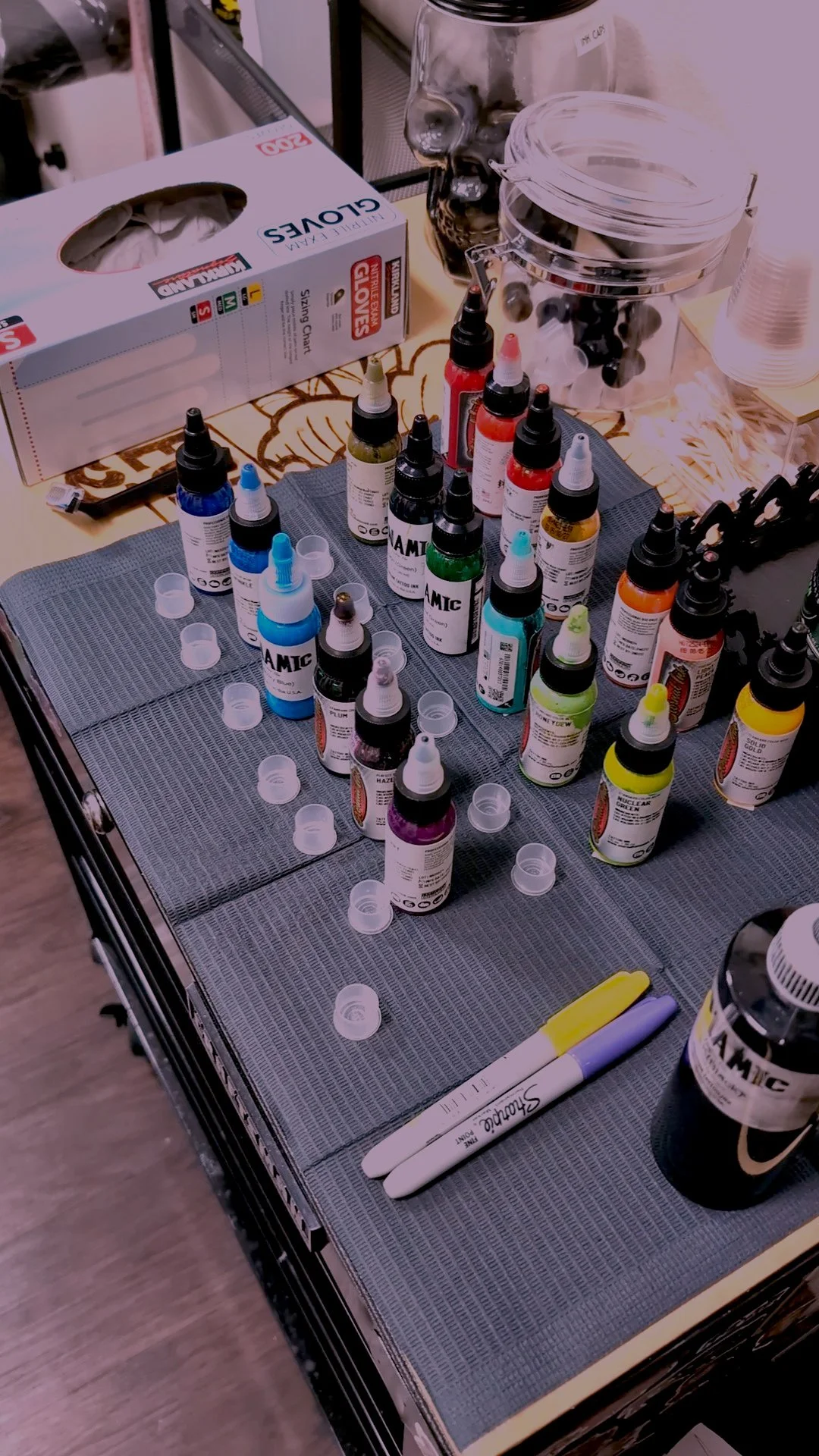
I research the products and inks that touch a client's skin before I use them. I research medication and healing interactions too, because pain management, antibiotics, and other prescriptions can all affect how skin heals and how it takes pigment. I want to be clear that this isn't medical advice and I'm not a doctor. It's due diligence, the kind any artist should be doing quietly in the background so a client never has to think about it.
When healing doesn't go the way it should, or a reaction shows up that wasn't expected, I don't guess. I dig into what actually caused it, whether that's a product, a technique, an aftercare gap, or something unrelated going on in a client's body, because guessing wrong means it can happen again. All of this exists in service of one thing: art that still looks good in twenty years, not just on the day it's finished.
Slowing a project down or adjusting a timeline isn't a punishment. It's the job. When a client's body reacts in a way that wasn't expected, or something about their health or circumstances comes to light mid project, adjusted safety measures aren't optional. They're mandatory. And here's where I hold a hard line: if a client rejects the safety measures put in place specifically to protect their skin, and is then upset when the piece isn't finished on the timeline they imagined, that outcome is not the artist's failure to manage. Protecting a client's body will always come before protecting a deadline. Always.
The Empathy Blind Spot
I'm autistic and ADHD, and I've learned to be honest about how that shapes the way I run this studio. My default setting is trust. It's care first, accommodation first, the benefit of the doubt extended further than most people would extend it. It's a huge part of why this space works for the clients who need it most.
But it also means the early, subtle signs/red flags of someone who is going to take advantage of that openness are genuinely harder for me to catch in real time. Not because I'm naive. Because the wiring that makes me good at building trauma-informed space is the same wiring that defaults to good faith before suspicion. That's a neurological reality and I've stopped treating it like something to be ashamed of.
What I can do is draw the line clearly once I see it. This space stays wide open for the people who show up and respect it. And the door closes, permanently and without negotiation, for anyone who uses that openness as an angle to exploit.
Tattoos Are Subjective, Not a Science
Tattooing is art. It is not math. And yet there's a strange, persistent habit in this industry of clients shopping a piece around mid process, looking for someone else to weigh in on work that isn't theirs to judge.
Here's the part nobody says out loud enough: every artist is going to say another artist's work is shit. Not because it's true. Because critique is currency in this industry, and there is always someone willing to spend it. I've seen it constantly. An artist glancing at someone else's healing or half finished piece and finding something to needle, often with zero context on the design conversations, the skin, the plan, or the client's actual goals.
Shopping around for outside opinions on a custom piece doesn't get a client closer to clarity. It introduces noise. It takes something built on trust between two people and hands a stranger a vote they were never part of. If a client has concerns about their tattoo, the artist doing the work is the person equipped to answer them.
The Unseen Ledger
There is a version of generosity in this industry that never gets talked about, because it isn't supposed to be transactional. Waived fees. Absorbed costs when something breaks. Comfort offered when someone needed to vent. Time, gear, and grace loaned out that never makes its way back. None of that is done expecting a return. That's what makes it generosity and not a business deal.
But there is a quieter truth underneath it: grace, flexibility, and real care are finite resources, not an endless line of credit. When they're treated like something owed, drawn on again and again without any reciprocity, it changes what that generosity costs the person giving it. Care isn't a loophole. Not anymore.
I've learned that lesson fully now, and I'm not extending unpaid, unprotected extras to anyone again. Policies, waivers, and documentation have all been rebuilt around that. And if there's one thing I hope for out of a lesson like this, it's that anyone newer in this industry, anyone just starting to see what the job really asks of a person, gets to learn it early: that grown adults will sometimes make their own disappointment your problem to manage, and that the answer isn't to stop caring. It's to stop handing out the parts of yourself that were never anyone's to take.
Evolution of the Studio's Armor
Every hard lesson in this business eventually gets turned into a system. Some of the mistakes I've had to learn from here weren't tattooing mistakes at all. They were business mistakes: gaps in paperwork, unstructured communication, no clear record of what was agreed to and when. Those are fixable, and I've fixed them.
Studio agreements and waivers have been tightened to remove ambiguity around scope creep, session pacing, and where shared responsibility sits between artist and client.
Art proofs and revisions are moving off unstructured texts and DMs entirely, replaced by a password protected client portal with a structured submission process.
And every preliminary sketch, concept, and un-inked design is now watermarked and carries an explicit copyright notice from the first draft onward. Original work stays original work, and it doesn't leave this studio unprotected again.

Stop to be safe, but one misbehaves
a witch has been crossed and one will be tossed
just sending on rage when one sets the stage
for betrayal and madness; yes, anger will ravage
reflect these misdeeds and fucking lie in the weeds.
so mote it be.